This is default featured slide 1 title

Go to Blogger edit html and find these sentences.Now replace these sentences with your own descriptions.

This is default featured slide 2 title

Go to Blogger edit html and find these sentences.Now replace these sentences with your own descriptions.

This is default featured slide 3 title

Go to Blogger edit html and find these sentences.Now replace these sentences with your own descriptions.

This is default featured slide 4 title

Go to Blogger edit html and find these sentences.Now replace these sentences with your own descriptions.

This is default featured slide 5 title

Go to Blogger edit html and find these sentences.Now replace these sentences with your own descriptions.

Monday, October 28, 2013

NES Replay: Pinball

Developer: Nintendo
Publisher: Nintendo
Released: 1985
Pinball machines are marvels of engineering. In each machine, there are so many servos, solenoids and motors that require careful precision and need to work in harmony, while still standing up to player use and abuse. It's stunning that any of them last a year, let alone for several years.

In 1985, pinball was still a pretty popular pastime. The machines stood in the arcades next to Pac-Man and Dig-Dug, but their time in the sun was about to fade. The video game boom almost ended up being the death of pinball. Why play a pinball game where only a few things can happen when you can play a video game where anything can happen? For that matter, why offer a pinball game in your arcade when you can offer a video game that breaks less and still rakes in the same amount of cash?

Oddly enough, though, instead of killing pinball, video games helped save it. We'd all love to have space in our house (and the disposable income) for a Doctor Who pinball machine, but we can't. The making of new pinball machines has almost ground to a halt. Arcades are dying, so there aren't any community places for pinball machines.
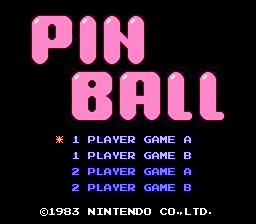
Yet, people still want to play pinball, and pinball video games filled the void. Early games like Pinball show why.

Pinball wasn't the first pinball video game. There was David's Midnight Magic for the Apple IIe and an unrelated game called Midnight Magic for the Atari 2600. However, what both of those games did was shrink down the board so it could all fit on the screen. They also hewed pretty closely to pinball conventions, with very few video game touches, as seen below:


When making Pinball, Nintendo decided not to shrink down the board, but rather to divide the board into two discrete screens. Players could move in between both screens with careful timing. That was an interesting choice, since it allowed for more detail on each board, which makes Pinball look more like a real pinball game. It also encourages the player to get to the top screen where points are more plentiful, while not penalizing the player as harshly for a missed flipper.

That also helps to improve pinball's interactivity. If pinball has a flaw, it's that the player only has control of the ball for a brief moment and then it's relinquished. By having three discrete screens each with flippers, the player has more time to work with the ball and more chances to make something happen. This is an idea that Nintendo has stuck with in later pinball games.

Nintendo also added ideas from video games into Pinball. Instead of just having the same old flippers and bumpers from normal pinball games, they could add in moving objects, minigames and other things that weren't possible in standalone pinball games.

Pinball purists may object to this idea. For them, pinball machines are kind of like jazz: You know that there are going to be certain things in a pinball machine, but what's exciting is how the pinball machine makers mix up the order and variation of the similar beats. By adding in video game elements, purists may argue, the essence of pinball is lost.

On the one hand I agree with that sentiment. Yet on the other hand, pinball's heyday is gone and it's never coming back. Maybe if players enjoy a pinball video game, they'll seek out the real thing. It could happen.

Either way, Pinball was a push in the right direction for pinball video games and was an excellent choice for a launch game.

Final Rating:


Thursday, October 24, 2013

Review: Pokemon X & Y

Developer: Game Freak
Publisher: Nintendo


Pokémon games are frequently ridiculed for being "just for kids." This is absurd. If Pokémon is just for kids, then we have some incredibly smart kids out there who apparently know how to put together a team with strengths and weaknesses, engage socially to get what they need and help others, and juggle a series of numbers and equations in order to keep everything straight.

So, way to go, kids!

However, Pokémon games have been stuck in a rut for a while, and there have always been a few major flaws that keep getting repeated in every new version. Black & White added a few more social features into the mix, but Black & White 2 literally retreaded the same ground. There haven't been a lot of new innovations in a while, just incremental improvements.

For instance, a lot of your time is wasted grinding, unless you happen to get a new Pokémon via trade. However, trading can be tedious if you have trouble finding a partner or put up a Pokémon for trade that no one wants.

Building up your team of Pokémon was always annoying too. In order to level up a weak Pokémon, you would have to start the battle with the weak one, then swap it out for the one you really wanted to use in order to get the weak one a share of the experience. It was time-consuming, and it would cause you to lose a move at the beginning of each battle. It could also leave your team lop-sided, as only a few of your Pokemon would be powerful and the rest in development.

No one ever really said anything about these things, though. After all, that was just Pokémon. It was part of the game series, and players had long ago either made their peace with the flaws or simply ignored the series.

Pokémon X & Y did something unthinkable: They actually went through and asked, "What is tedious in Pokémon and how can we fix it?" There was no real reason for them to do this, since even lesser entries of the Pokémon series sell enormous amounts, yet they really rethought things. That led to lots of fantastic changes that make X & Y the best iteration of Pokémon yet.

For one, level grinding is severely reduced in the game. If you want to spend some time grinding, fine. If you don't, you don't have to, since the X & Y is far more balanced than previous versions. Encounters also will net you more experience, meaning that you'll gain levels a lot faster, get better evolutions a lot quicker and get to the fun parts of Pokémon instead of wasting your time messing with the same old parts.

You can also get an item that shares your experience points throughout your party that you can turn on and off at a whim. This is huge. No longer do you have to swap your Pokémon in order to get them experience in battle. It saves so much time that was otherwise wasted, and helps keep your party balanced for when you really need it.

Speaking of fun parts, one of my pet peeves about Pokémon was always that there was no real incentive for capturing new Pokémon. Sure, the point of the game is to find and collect Pokémon, but there were no tangible in-game benefits for doing so. In X & Y, they've fixed that. Now, you get experience points for capturing OR defeating Pokémon. It's such a basic change, but it makes a huge difference.

Another great feature is the new Wonder Trade system. You put up a Pokémon for trade and get matched up with another random trading partner. You must accept their Pokémon, no matter if you want to or not. If you trade away a level 50 Raichu and receive a level 2 Bidoof in return, tough cookies. However, if you trade away a level 4 Pansear and get back a level 60 Gyarados, score!

I absolutely love Wonder Trade. You never know what you're going to get. Sure, sometimes you'll get some garbage, but you can always turn around and trade it again. It's like a Pokémon slot machine, and it's never not exciting.

Another great feature is the ability to send other players bonuses. If you so desire, you can send other players abilities like an HP restore, improved catch power or improved attack power. Combined with Wonder Trade, it's really quite nice. If you get a really nice Pokémon via trade, you can send bonuses to the sender in gratitude. One time I traded away a Farfetch'd and got bonus after bonus from the grateful party. It feels good.

That being said, there are some purists who aren't happy about these changes. Fortunately, if you want to struggle through Pokémon the way you always do, you can turn off most of these improvements. I don't understand why you would, but you can if you want. However, I really cannot fathom what's the big deal. Nintendo and Game Freak have taken a game series that was good and made it better. Some people will complain about any change, I guess.

The only legitimate complaint on Pokémon X & Y is the very, very slight story. The plot in X & Y is the same as every other Pokémon game: You're a kid. You get a Pokémon. You try and capture other Pokémon in an attempt to catch them all. You go to eight gyms and get badges. Some evil group wastes their time try to use Pokémon to take over the world. Eventually, you beat the evil group and take on the four toughest trainers in the world. Lather, rinse, repeat. If you're looking for a major change to this formula, you're not going to find one.

That being said, there is just so much to love about Pokémon X & Y that one measly review couldn't do it justice. I'll put it this way: If you always liked the idea of Pokémon but could never get into the games, Pokémon X & Y is an excellent place to start. If you liked previous Pokémon games, get X & Y right now.

Final Rating: A-

Monday, October 21, 2013

Read This: Nintendo's New Type of Game

A great article from Kotaku about Nintendo's new game genre they both invented and perfected.

NES Replay: Mach Rider

While Nintendo may currently be shorthand for "bright-colored family-friendly games," that's not entirely fair. They've made their share of games for mature audiences, culminating in the bloody Japan-only Wii game Zangeki no Reginleiv. While Mach Rider isn't by any means a bloody game, it has a surprisingly grown-up premise and could conceivably appeal more to adults than children.

The reason, therefore, that Nintendo doesn't make more violent games isn't because they can't. It's just that their happy-go-lucky games sell better.

Mach Rider has a really cool premise: You're a motorcycle-riding, machine-gun-wielding post-apocalyptic warrior racing wildly through the wasteland while fending off attackers. It's a really fast racing game, and wholly out of character with what Nintendo stands for now. It's gritty. It's got guns and explosions. It's not bad.

Mach Rider has some flaws, for sure. First of all, there are far too many hazards on the tracks. There are oil slicks, water puddles, barrels along the side of the road that you can collide with and sharp turns, as well as enemy racers who are trying to get him killed. This is a game that demands that the player absolutely memorize the tracks in order to master them, but I could see someone getting really good at knowing just when to downshift into a turn and when to open up the throttle.

It's also way too easy to get Mach Rider killed. If you accidentally bump in to one of the rival motorcycle-riding baddies, they can kill you. You can try and shoot them down, but you can only shoot directly in front of you and you have limited bullets. Since there are so few straightaways, that means you're spraying everything with bullets and never really hitting your targets.

There's also a track creation feature, just like in Excitebike. However, just like Excitebike, this also used the Famicom Data Recorder that never made it to Western shores. You can create a track, but you can't save it.

However, Mach Rider is a technically impressive game. The racing is fast. I mean, really fast. It's shockingly fast for an NES launch game, and it shares similar DNA with Nintendo's later F-Zero for that reason. The physics feel the same, but F-Zero's track is wider and there are fewer hazards on the road.

Mach Rider also manages to evoke a feeling of desolation surprisingly well with its limited color pallette. Before I even knew what the premise of Mach Rider was, I immediately felt like I was playing The Road Warrior.

But Mach Rider never really got a chance to connect with audiences. Super Mario Bros. was so good and so popular that it overshadowed almost every other launch game. The success of Super Mario Bros. sealed the fate of lesser, grittier games like Mach Rider. There was no room for a post-apocalyptic motorcyclist in this new, candy-colored future.

So, Mach Rider was forced to forever ride his motorcycle into the sunset, cast aside by the future he no longer belongs to. The dirt cakes on his face, the chrome of his motorcycle glistens in the burnt-orange light of the setting sun. He rides on.

Final Rating:


Wednesday, October 16, 2013

Why Did I Restart NES Replay?

A few people may be wondering why exactly NES Replay got restarted. I originally started going alphabetically, then stopped and rejiggered everything to go chronologically instead. This is weird to some, since there are a lot of NES reviewers around, and all of them are going alphabetically. Why can't I do that?

At first, my intentions were to just review the games like normal. "Is this a good game? Is this a bad game? Why or why not?"

As I began reviewing, though, I found that I couldn't just review each game in a vacuum. Some games were reactions to other games. Some games were amazingly innovative yet flawed. Some were horrible, horrible dreck that deserved to get dumped on. Either way, there was a wide variety of reasons that each game turned out the way that it did.

I started writing my e-book, NES Replay Vol. 1. It was supposed to contain the first 50 reviews along with histories and company profiles. None of it seemed to mesh, though. I was hopping around in time: Explaining why the Crash of 1983 happened, why the NES was important, then leaping ahead 10 years to an unrelated game, then jumping back to 1988, then reviewing a launch game. It was too scattershot, but I had already started my Kickstarter and there was no going back.

The final straw was when I sent the book to a friend of mine for editing. He started looking at it, and then I didn't hear from him for a week. I finally cornered him and he told me that it didn't make sense, that it needed to be chronological in order to fit.

I had to agree, and I got really bummed out. I had already sunk a year into this project, and now I'd have to start over?


Finally, I got my act together and dove back in. I'm having much more fun than I ever did before, and it's much easier to write each entry because they actually make sense.

There's one major problem: The rating system doesn't make sense anymore. The games can't be cleanly divided into "Good," "Middling," and "Bad". Since these aren't reviews in the classic sense, having a classic review system doesn't fit.

I looked through my previous reviews and realized that most every game falls into these categories:


The best of the best. Reserved for games that deserve permanent preservation.


Fun games that will make you smile.


They tried something new but it didn't quite come together.


Uninspiring at every level.


The worst of the worst. These games need to be baled together and burned like firewood.

So, for example, Adventures of Lolo 3 is a Classic. Kung Fu is Good. Anticipation is a Noble Failure. Ice Climber is Poor. The Adventures of Gilligan's Island is Awful. I'm going to go back through previous reviews and fix the ratings for each game, so that'll take some time.

So I hope that you understand why these changes were made, and I hope you continue following me onwards as we examine the NES. If you have any questions, please don't hesitate to email me at lee (at) downwardscompatible.com.

Thanks!